精選內容

Self Introduction

Hello, friends. This is Jason, an ocarina lover, wanting to introduce the lovely musical instrument “Ocarina" to the world. Enjoy my blog and the great music.

Be yourself and do what you want

— Author:Jason Chen。

This is the blog about ocarina. Please be exciting about every information upgraded in this blog and hoping to help you more recognize this lovely musical instrument “ocarina". If you love my blog, please click subscribe down below.

Taiwan Ocarina Player—Kuolong

Today, I would like to introduce a famous ocarina player and maker in Taiwan—Kuolong. Following I’ll put some connect that I like about his great music, you can click them to his website or movie website.

Taiwan ocarina players:Kuolong

Kuolong’s website: http://www.pankuolong.url.tw/

Movie1(Being in Love “Those Years")

Movie2(the forest we met)

Movie3(precious chrysanthemum)

Movie4(Akogare)

Movie5(月夜の森)

Movie6(七夕)

Movie7(連理枝)

Movie8(벚꽃내리는밤 櫻花飄落的夜晚)

Movie9(If we can meet again)

Movie10(搖啊搖 搖到外婆橋)

Movie11(Melodies of Life)

How to play ocarina

〈For 6 or 7 holes ocarina〉 一、Put both index finger and little fingers on the front of four holes, and thumbs on the back. Using ring fingers and little fingers to hold the ocarina on it’s bottom.
二、Blow as playing other musical instruments(abdominal breathing), use your nose to inhale the air and your mouth to blow. The air you blow must be enough and have to be focused on the point that makes ocarina sounds perfect.
三、Put two lips on the mouthpiece, and put your tongue on the up row inner side of your teeth and move it when you blow, just like making the sound “tu".
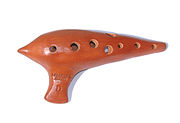
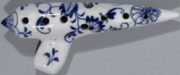
〈For 12 holes ocarina〉 一、Use ten fingers to play ocarina. Use your fingertips which on the first joint of your fingers to softly hold the holes and you have to check your fingers must wholly hold them.
二、Blow as playing other musical instruments(abdominal breathing), use your nose to inhale the air and your mouth to blow. The air you blow must be enough and have to be focused on the point that makes ocarina sounds perfect.
三、Put two lips on the mouthpiece, and put your tongue on the up row inner side of your teeth and move it when you blow, just like making the sound “tu".
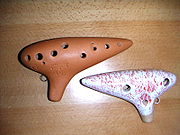
Types of ocarina

There are many different styles of ocarinas varying in shape and the number of holes:

  • Transverse (Sweet potato) – This is the best known style of ocarina. It has a rounded shape and is held with two hands horizontally. Depending on the number of holes, the player opens one more hole than the previous note to ascend in pitch. The two most common transverse ocarinas are 10-hole (invented by Giuseppe Donati in Italy) and 12-hole.
  • Pendants
    • English Pendant – These are usually very small and portable, and use an English fingering system (4–6 holes).
    • Peruvian Pendant – Dating from the time of the Incas, used as instruments for festivals, rituals and ceremonies. They are often seen with designs of animals. They usually have 8–9 holes.
  • Inline – These are often called a “fusion" of the pendant and transverse ocarinas. This style is known for being very small and compact, with more holes than the pendant. This allows one to ascend in pitch with the linear finger pattern rather than finger combinations.
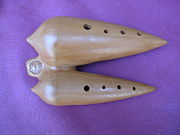
  • Multi-chambered ocarinas (better known as “double" and “triple" ocarinas) – exist within the three broad categories of ocarina. These ocarinas overcome the ocarina’s usual limited range of notes. A transverse double ocarina typically plays two octaves plus a major second, and a transverse triple ocarina plays with a range about two octaves plus a fifth. Double ocarinas for pendant and inline ocarinas also exist. Double inline ocarinas are specially designed to play chords, for harmonic playing.

Several makers have produced ocarinas with keys, mostly experimentally, beginning in the late 19th century. Keys and slides either expand the instrument’s range, help fingers reach holes that are widely spaced, or play notes not in the native key of the instrument.

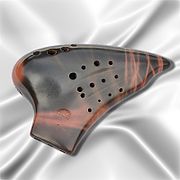
A transverse ocarina
Meissen “Blue Onion" pattern porcelain transverse ocarina, early 20th century
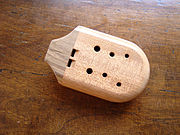
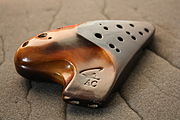
Front and back view of transverse ocarinas. The double holes on front indicate a fingering system developed in 20th-century Japan.
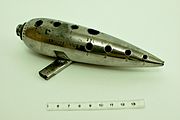
Metal transverse ocarina of 1875
The English pendant ocarina, invented in the 1960s by John Taylor, produces an entire octave using just four finger holes
English pendant ocarina (unstrung, with two suspension holes)
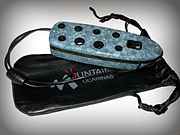
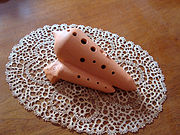
An inline ocarina.
A double-chambered inline ocarina
A double-chambered English pendant
A double-chambered transverse ocarina (mouthpiece on the side)
An Asian double chambered ocarina. The two blow holes in the mouthpiece are clearly visible, which makes it possible for the player to play an extended range of notes (17 in total, in this case from A4 to C6)
A triple-chambered ocarina in the bass register
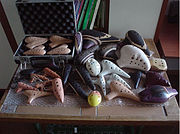
A collection of ocarinas
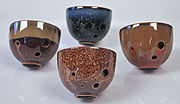
Selection of novelty “teacarinas" that are also functional teacups
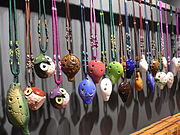
Owl-shaped ocarinas on sale in a shop in Taiwan.
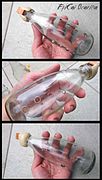
Ocarina made from a bottle
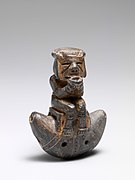
A ceramic pre-Columbian ocarina, ca. 1300-1500, Tairona people, Sierra Nevada de Santa Marta, Colombia
在 WordPress.com 上免費建立自己的網站。建立你自己的網站。
免費開始使用