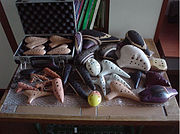
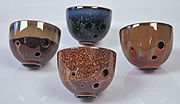
There are many different styles of ocarinas varying in shape and the number of holes:
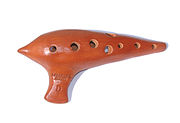
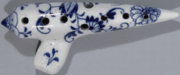
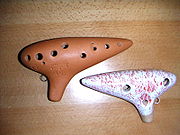
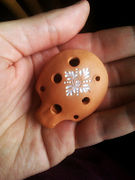
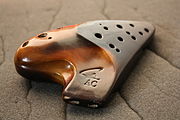
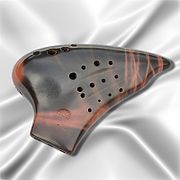
- Transverse (Sweet potato) – This is the best known style of ocarina. It has a rounded shape and is held with two hands horizontally. Depending on the number of holes, the player opens one more hole than the previous note to ascend in pitch. The two most common transverse ocarinas are 10-hole (invented by Giuseppe Donati in Italy) and 12-hole.
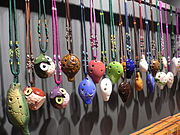
- Pendants
- English Pendant – These are usually very small and portable, and use an English fingering system (4–6 holes).
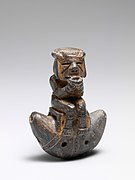
- Peruvian Pendant – Dating from the time of the Incas, used as instruments for festivals, rituals and ceremonies. They are often seen with designs of animals. They usually have 8–9 holes.
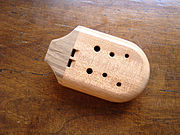
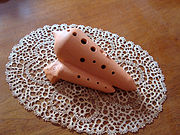
- Inline – These are often called a “fusion" of the pendant and transverse ocarinas. This style is known for being very small and compact, with more holes than the pendant. This allows one to ascend in pitch with the linear finger pattern rather than finger combinations.
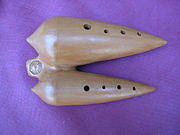
- Multi-chambered ocarinas (better known as “double" and “triple" ocarinas) – exist within the three broad categories of ocarina. These ocarinas overcome the ocarina’s usual limited range of notes. A transverse double ocarina typically plays two octaves plus a major second, and a transverse triple ocarina plays with a range about two octaves plus a fifth. Double ocarinas for pendant and inline ocarinas also exist. Double inline ocarinas are specially designed to play chords, for harmonic playing.
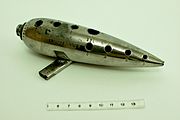
Several makers have produced ocarinas with keys, mostly experimentally, beginning in the late 19th century. Keys and slides either expand the instrument’s range, help fingers reach holes that are widely spaced, or play notes not in the native key of the instrument.



 Jason blog